The Importance of Design and Cleanliness in High Purity Cylinder Valves
Mitigating Catastrophic Risks Through Proven Engineering – The KOHDA-Cavagna Valve Approach

By Stephan Gamard, PhD, DTech, Specialty Applications Director, Cavagna Group
In high-purity, corrosive, and toxic gas services, the design and cleanliness of cylinder valves are not just operational details—they are critical safety determinants. Even a single particle, droplet of moisture, or trace amounts of incompatible material can trigger chain reactions leading to leaks, fires, or explosions. Real-world incidents have demonstrated that inadequate valve design or cleanliness has caused fatalities, equipment destruction, and extended production downtime.
This paper examines the technical pathways that turn minor contamination into catastrophic failure, reviews documented industry incidents, and explains how the KOHDA-Cavagna high-purity valves—manufactured in Japan for Cavagna—address these risks through robust design, stringent materials selection, ultra-clean manufacturing, and proven field performance.
Introduction
Cylinder valves are the primary control interface between compressed gases and the systems they feed. Yet, in many operations, they are the most overlooked component in contamination control. For high-purity, corrosive, and toxic gases, even trace amounts of foreign material — whether particulates, moisture, hydrocarbon residues, or incompatible materials — can initiate catastrophic failures.
Documented industrial incidents have shown that design flaws and cleanliness lapses at the valve interface can result in:
- Explosive fires
- Violent decompression with mechanical damage
- Toxic gas releases endangering personnel and the public
- Accelerated corrosion-driven leaks
The consequences range from costly equipment loss to severe injuries and fatalities.
The following sections examine the mechanisms behind these hazards, review relevant incidents, and outline how the KOHDA-Cavagna valves are engineered to prevent them.
Valve Design: The First Line of Defense
The Risk
Silane, widely used in the semiconductor industry for more than 30 years, illustrates the risks posed by inadequate valve design and cleanliness. As reported by Peng et al.[1], improper design and cleanliness in the cylinder valve have resulted in catastrophic consequences including explosive fires and fatalities.
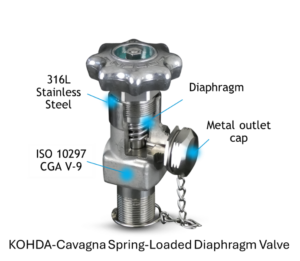
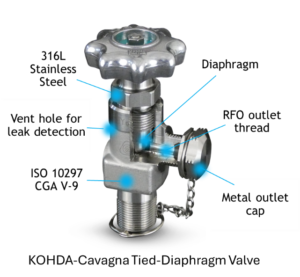
Valve technology has evolved from packed valves to spring-loaded diaphragm designs, and more recently to tied-diaphragm configurations, to meet ultrahigh purity and integrity requirements. However, major international standards such as ISO 10297[2] and CGA V-9[3], while necessary for baseline design and qualification criteria, offer limited guidance on optimal performance in high-consequence gas service.
The KOHDA-Cavagna Solution
With a proven design based on decades of direct field experience, the KOHDA-Cavagna valves are designed from the ground up for gas-specific compatibility and high-integrity sealing:
- Gas-specific design verified using ISO 11114-1[4] and -2[5] compatibility protocols.
- Spring-Loaded and Tied-diaphragm designs to minimize potential leak paths and particle generation.
- Precision machining and surface finish to reduce particle shedding and moisture retention.
- Reduced gas wetted areas to minimize leak and contamination pathways.
- Qualification beyond minimum standards, using individual helium leak testing exceeding 1×10⁻⁷ atmcc/sec.
Manufacturing and Pre-Use: Eliminating Latent Hazards
The Risk
Minor surface defects can escalate into major safety incidents. For example, an explosion at Osaka University in 1991[6] was traced back to a degraded O-ring in a silane/nitrous oxide system. Oxygen applications have, unfortunately, a long history of ignition incidents resulting from introduction of flammable components during the manufacture and storage processes[7].
The KOHDA-Cavagna Solution
Every KOHDA valve is:
- Individually assembled and tested in cleanroom conditions to prevent pre-installation contamination.
- Supplied with metallic, fully sealing outlet caps to maintain cleanliness until the point of use.
- Manufactured with materials that resist corrosion even in aggressive gas service.
Valve Operations: Where Technique Meets Safety
The Risk
Unsafe operation can bypass even the best design. Assembly to ancillary pressurized equipment should be handled with care, examining the adequacy and compatibility of materials and connections to the intended application. For instance, a poorly designed connection led to a severe fire in a storage gas facility in France that took over 8 days to fully extinguish[8].
Following use, proper attention should be paid to closing the valve without damaging it. The lines should be purged, sealing outlet caps put back on, and the packages stored in dry, clean, and ventilated area with proper valve protection. Plastic dust caps, common in cost-sensitive applications, offer minimal sealing capability. Consequences for a missing, damaged, or leaky outlet cap can be catastrophic as experienced on the Asiafreighter incident in 1974[9].
Maintenance and removal should follow manufacturer and industry guidelines. Even after years of non-use, a cylinder-valve package can still be dangerous![10]
The KOHDA-Cavagna Solution
- Metallic sealing outlet caps compatible with the intended gas.
- Operational guidance provided based on service-specific risks, including disposal instructions.
- Low-torque, precise sealing mechanisms to avoid over-compression damage.
Conclusions
When designed and operated safely, cylinder valves can properly store and release contained gas in a safe manner for years. In specialty gas applications, however, consequences of improper design, manufacturing, or use of a cylinder valve can result in severe safety incidents including fire, explosions, and fatalities. Special attention should be paid during the valve selection, purchase, installation, and use to minimize risks.
KOHDA-Cavagna high-purity valves—manufactured in Japan for Cavagna—combine proven engineering design, rigorous cleanliness controls, and comprehensive testing to deliver unmatched safety and reliability. Each valve is helium leak tested, individually assembled and tested in cleanroom packaging, and equipped with a metallic sealing outlet cap. With decades of successful deployment in critical gas services, the KOHDA-Cavagna valves stand as a benchmark for mitigating contamination risks and preventing catastrophic failures in specialty gas applications.
This article provides general information about pressure regulation. The words and other contents provided are not intended and should not be construed as warranties, guarantees, or technical advice. If a reader wants assistance to select the proper product for their application, please Contact Cavagna North America.
__________________________________________________________________________________________________________________________
[1] Peng, D.-J., Chang, Y.-Y., Wu, H.-C., Tsaur, C.-C., & Chen, J.-R. (2008). “Failure analysis of a silane gas cylinder valve: A case study.” Engineering Failure Analysis, 15, 275–280. https://doi.org/10.1016/j.engfailanal.2007.03.004
[2] ISO 10297:2024 Gas cylinders – Cylinder valves – Specification and type testing. https://www.iso.org/standard/81026.html
[3] Compressed Gas Association V-9 – 2024 Ninth Edition. Standard for Compressed Gas Cylinder Valves. http://www.cganet.com
[4] ISO 11114-1:2020. Gas Cylinders – Compatibility of cylinder and valve materials with gas contents. Part 1: Metallic materials. https://www.iso.org/standard/76081.html
[5] ISO 11114-2:2021. Gas Cylinders – Compatibility of cylinder and valve materials with gas contents. Part 2: Non-metallic materials. https://www.iso.org/standard/77832.html
[6] https://www.shippai.org/fkd/en/cfen/CA1000614.html
[7] TR-107 Special Report: Fires Involving Medical Oxygen Equipment
[8] FD_15208-chalon-sur-saone_JLC-IH_GB_Vfinal05082010
[9] https://hmexassistant.com/wp-content/uploads/2023/07/Asiafreighter-Arsine-Incident.pdf
[10] https://www.sciencedirect.com/science/article/abs/pii/S1350630799000369