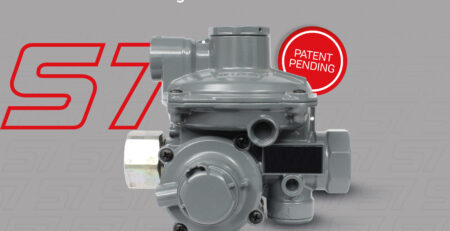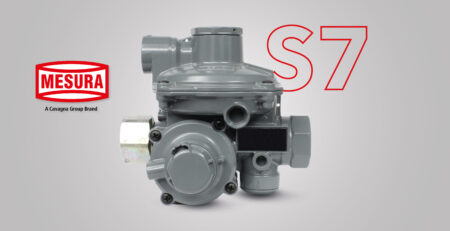
Limited Internal Relief Valves available on the Mesura S7 and S9 regulators
Limited Internal Relief Valves available on the Mesura S7 and S9 regulators
Across North America, many gas distribution companies are utilizing pressure regulators with integral slam-shuts as one solution to improve safety and reduce venting requirements. Regulators with integral slam shut valves (SSVs) are commonly referred to as Vent Limited Regulators, yet this term is not well-defined. Several standards may need to be reviewed when assessing regulator configurations for residential and commercial service.
For indoor regulators, NFPA 54 states that regulators shall be vented outdoors, excluding regulators with vent limiting means listed in accordance with ANSI Z21.80/CSA 6.22. ANSI Z21.80/CSA 6.22 is a harmonized standard for Line Pressure Regulators, also known as appliance regulators, similar to the regulator in Figure 1 below. Z21.80/6.22 defines a Vent limiter as a device that shall limit the flow through the vent of the regulator to 2.5 CFH of natural gas. However, that standard does not apply to most residential and commercial service meter applications as it only specifies inlet pressures up to 10 psig, Additionally, Vent Limiters are typically designed only for indoor service. Instead, most residential and commercial service regulators conform to ANSI B109 standards.

Figure 1: CSA 6.22 Certified Line Pressure Regulator
ANSI B109.5 defines Limited relief as “a relief valve with a capacity up to 2.5 scfh (0.07 Sm3/h) at specified conditions.” Other types of Internal relief valves (IRVs), such as token or low flow IRVs, can have a wide range of venting rates specified by the manufacturer, based on the application. A Limited Relief, according to B109.5, must limit the flow to 2.5 SCFH, which is the same vent rate allowed inside a building according to Z21.80/6.22 and NFPA 54.
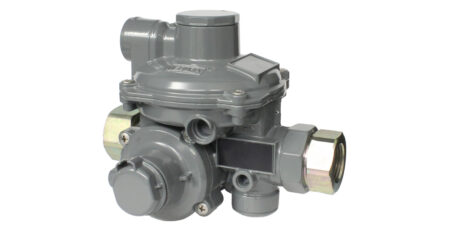
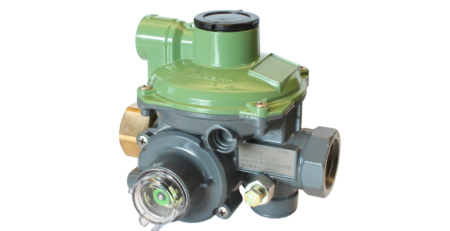
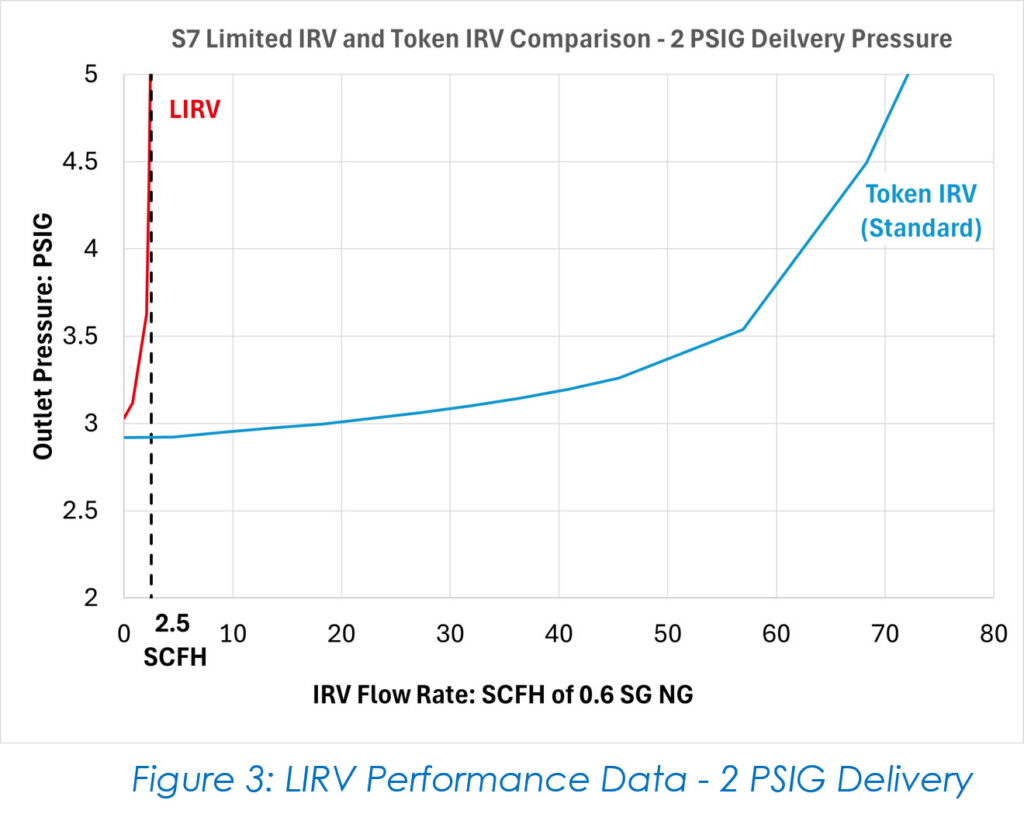
The Mesura S7 and S9 regulators now offer our patent-pending Limited Internal Relief Valve (Limited IRV), which is designed to limit the IRV capacity to no more than 2.5 SCFH of NG for outlet pressures up to 2 psig (for low pressure delivery) or 5 psig for medium pressure delivery. Figures 2 & 3 below show the Limited IRV performance data. The Limited IRV has a start-to-discharge and reseat like a typical IRV, while limiting vent flow within specified conditions.
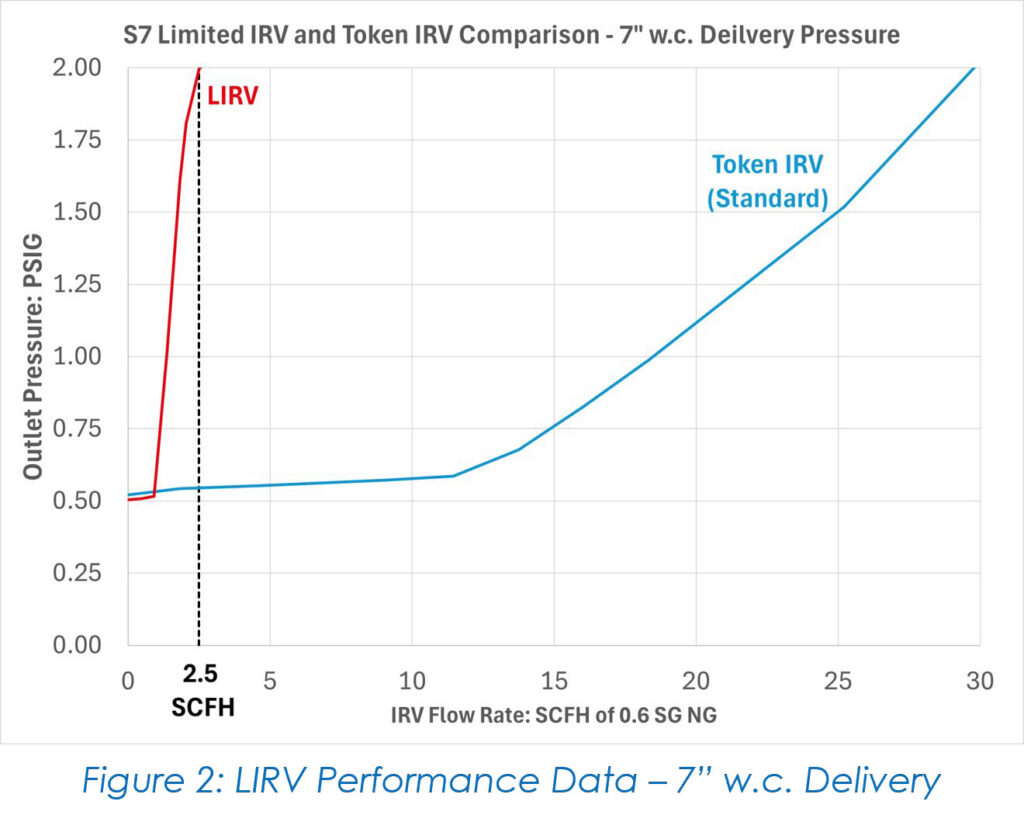
Note that the Limited IRV is not a safety device and is not intended to replace the regulator’s primary overpressure protection or any system-level safety device required for the application. The Limited IRV is designed to release small amounts of gas during minor upset conditions such as thermal expansion, rapid shutdown, or imperfect shut off.
The safety device of the S7 and S9 is the integral slam shut, featuring Over Pressure Shut Off (OPSO) and optional Under Pressure Shut Off (UPSO). The Limited IRV is designed to vent up to 2.5 SCFH until the OPSO activates, to reduce nuisance activations of the slam shut device. OPSO set points must be selected by qualified personnel based on the MAOP of the downstream system and relevant codes.
| Vent Limiter | Limited Relief or Limited IRV | Token IRV | |
|---|---|---|---|
| Venting Rate | 2.5 SCFH | 2.5 SCFH | >2.5 SCFH* |
| Relevant Standard | ANSI Z21.80/CSA 6.22 | ANSI Z21.80/CSA 6.22 & B109.5 | Undefined |
| Available On | Z21.80/6.22 Line Pressure Regulators | Mesura S7 and S9 Regulators | Most self-operated regulators |
* Mesura Token IRV rates can be seen from Figures 2 & 3, but Token IRV rates will vary based on manufacturer and application.
To further minimize regulator venting, the Mesura S7 and S9 with Limited IRV also feature a Safety Diaphragm, or secondary diaphragm, in addition to the regulating diaphragm. This means that if the primary diaphragm fails, the Safety Diaphragm is designed to provide a secondary means of containing gas and keeping the regulator operational. The Safety Diaphragm features a Micro-Vent designed to allow <1 SCFH of gas to vent through the Safety Diaphragm to provide indication of an upset condition.
For Outdoor Installations:
In the USA, a 3-foot clearance is common around the regulator vent from any ignition sources or mechanical intakes. Product selection and venting design should always be reviewed against applicable codes and standards. Since the Limited IRV conforms to the venting requirements of indoor regulators, the Limited IRV may be used to reduce the need for any vent piping on outdoor meter sets once approved by local and state authorities.
Depending on your area, local codes and regulations may not mention the use of Limited Reliefs or Limited IRVs without vent piping. This article may be referenced to provide information on the relevant standards to be considered. For additional information, a report prepared for PHMSA (#693JK32110001) by GTI Energy provides methane concentration data for Limited IRV designs. This study shows the gas concentration when vent rates are limited to 2.5 SCFH, where gas concentrations are measured at 1, 2 and 3 ft distances from the regulator vent. The report can be found at the link below and should be thoroughly reviewed to evaluate assumptions and the relevance of test conditions to each application. For help reviewing this report, or if additional information is needed for local regulations, please contact Cavagna North America.
For Indoor Installations:
To address vent-limiting requirements associated with some indoor applications, many users reference ANSI Z21.80/CSA 6.22. While a Limited IRV is designed to meet the vent rate requirement of that standard, it also states that a vent limiter shall be made of materials having melting points of not less than 800 ⁰F. In some applications, a thermal activated shut off may be used to conform with the temperature requirements of the Z21.80/6.22 standard. A thermal activated shut off is designed to stop the flow of gas when activated, typically before 250 ⁰F. Thermal activated shut offs can be used outdoors as well, and are available as independent devices or integrally mounted on your Mesura S7 and S9 regulators.
The Mesura S7 and S9 are also available with a CSA 6.22 compliant vent limiter installed in the vent of the integral slam shut device. In appropriate configurations, the vent limiter, together with an Under Pressure Shut Off (UPSO) is designed to protect from tears in the slam shut diaphragm and limit venting rates to 2.5 SCFH.
Summary
Through the integral safety devices offered on the Mesura S7 and S9, such as the Limited IRV, Safety Diaphragm with Micro-Vent, OPSO, Thermal Activated Shut-off, and UPSO, users have access to a broad range of safety features. These product features offer additional design options and may simplify regulator installation by reducing the necessity of vent piping. Final product selection, installation, and code compliance shall be determined by the customer, installer, or qualified engineer based on the specific application, applicable codes, operating conditions, and current product documentation.
This article provides general information about pressure regulation and is not legal or code-compliance advice. Cavagna group does not assume responsibility for selection, use, or maintenance of any product. The purchaser and end user remain solely responsible for proper selection, use, and maintenance as well as compliance with all applicable codes and standards. The words and other contents provided shall not be construed as warranties, guarantees, or technical advice. If a reader wants assistance to select the proper product for their application, please Contact Cavagna North America.
WARRANTY TERMS AND GENERAL TERMS AND CONDITIONS OF SALE ARE AVAILABLE AT www.cavagnagroup.com. CAVAGNA GROUP RESERVES THE RIGHT TO MODIFY OR CHANGE THE DESIGN, SPECIFICATIONS, OR FEATURES CONTAINED IN THIS DOCUMENT AND THE PRODUCTS SHOWN HEREIN. CONTACT CAVAGNA GROUP FOR THE LATEST INFORMATION